June 23, 2025
•By Anix AI Team
•AI Workflows
Designing AI Workflows: How to Build Repeatable, Scalable Automations
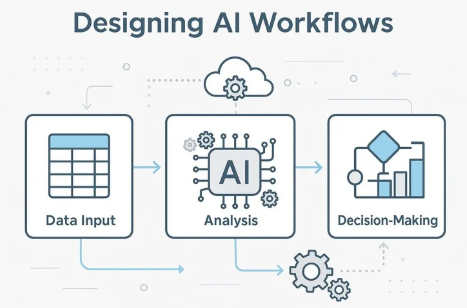
In today’s digital economy, organizations are under constant pressure to streamline operations, reduce manual intervention, and scale faster than ever before. While artificial intelligence (AI) has emerged as a powerful enabler, deploying AI in an ad hoc manner often leads to inconsistent outcomes and siloed efficiencies. The real value lies in creating structured AI workflows that are not only intelligent but also repeatable and scalable across business functions.
Understanding AI Workflows
An AI workflow is a connected series of steps where data is captured, interpreted, and acted upon by a combination of AI models, business logic, and automation rules. Unlike one-off scripts or RPA bots that mimic clicks, AI workflows are built to adapt, learn, and integrate within larger systems.
At the core of a successful AI workflow lies the ability to handle variable data inputs, make intelligent decisions, and execute tasks automatically while maintaining transparency and control. These workflows don’t just improve productivity—they introduce intelligence into the operational backbone of the business.
Laying the Foundation for Repeatability and Scale
The first step in building a scalable AI workflow is ensuring standardized, clean input. Whether you’re processing forms, emails, or documents, data quality directly impacts the effectiveness of AI models. Technologies like Optical Character Recognition (OCR) and form parsers can help convert unstructured data into usable formats. Once digitized, validation layers ensure data consistency before it moves through the workflow.
Scalability also hinges on modular design. Instead of creating rigid, single-use automations, businesses should develop modular tasks—discrete units that can be reused or reconfigured. For instance, a classification model built for customer emails can also be used in complaint handling or support ticketing systems. Low-code AI platforms are especially helpful here, allowing operations and business teams to collaborate on workflow creation without deep technical expertise.
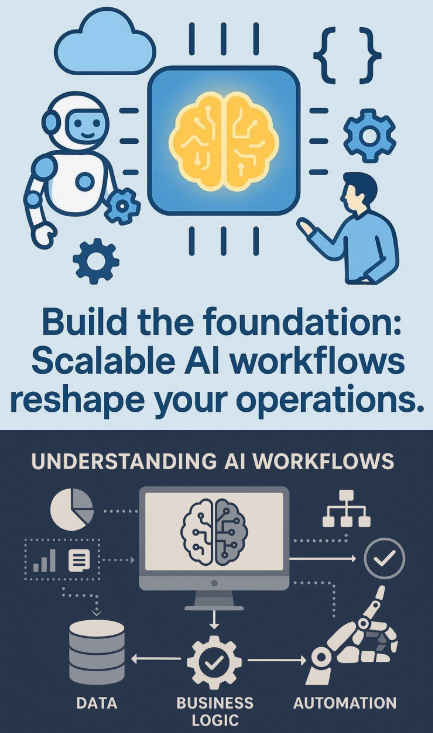
Scalable AI Workflow Diagram
Decision-Making and Integration
Decision-making is where AI adds the most value. Well-trained models can take over routine choices such as routing documents, scoring leads, or approving transactions. However, to ensure reliability, workflows should include confidence thresholds. When AI is unsure, it should escalate to a human-in-the-loop. This not only builds trust in automation but also ensures compliance and quality control.
Integration is another essential pillar. A truly scalable AI workflow doesn’t exist in isolation. It connects seamlessly to existing tools like CRMs, ERPs, document management systems, or customer portals. With APIs or middleware solutions, businesses can automate end-to-end processes—eliminating handoffs, delays, and duplication of effort.
Continuous Learning and Improvement
Perhaps the most defining trait of a well-designed AI workflow is its ability to learn. Embedding feedback loops into the workflow enables continuous improvement. When users correct an error or override a decision, the AI model should capture this behavior and adjust accordingly. Over time, this iterative learning leads to greater accuracy and better decision quality.
The Real Benefits of Scalable AI Workflows
Businesses that invest in scalable AI workflows enjoy consistent execution across teams and locations. Rather than reinventing the wheel for each process, they build once and deploy many times—with the ability to customize or expand when needed.
Operational agility improves significantly. As market conditions or regulations change, AI workflows can be updated faster than traditional manual processes. This responsiveness becomes a strategic advantage, especially in competitive or highly regulated industries.
Accuracy also improves over time. With AI learning from data and feedback, errors decrease and reliability increases—reducing the need for rework or double-checking. From a cost perspective, scalable workflows help avoid the high overhead associated with hiring more staff to handle repetitive work. Instead, organizations can redirect human effort toward decision-making, customer experience, and innovation.
Applying AI Workflows Across the Business
AI workflows are being applied across a wide range of use cases today. In customer service, AI can classify incoming messages, generate automatic replies, and escalate complex issues to the right team—all while learning from each interaction. In finance, invoice validation, fraud detection, and reconciliation tasks are now handled by intelligent workflows that connect multiple systems in real-time.
Regulatory compliance is another high-value domain. AI workflows can scan documents, flag non-compliance, and generate audit-ready reports without manual intervention. In marketing and sales, lead scoring, campaign personalization, and pipeline forecasting can all be streamlined through intelligent automation.
These examples highlight a key insight: the value of AI increases significantly when it operates across systems and departments, not just within them.
Best Practices for Success
To build AI workflows that last, businesses should start with a clear use case—preferably a process that’s high in volume, prone to human error, or currently causing delays. Map out each step from input to output and identify where AI can drive efficiency.
Choose tools that not only offer machine learning and NLP capabilities but also support integration and human intervention when needed. Focus on building workflows that are modular, easy to update, and compatible with other systems.
Testing and iteration are key. Monitor performance closely, collect feedback, and make incremental improvements. Over time, these improvements compound, leading to highly effective, enterprise-grade automation.
Finally, design with reuse in mind. The best AI workflows are not one-offs—they’re frameworks that can be applied across teams, processes, and regions, ensuring that every new implementation is faster and more cost-effective than the last.
Conclusion
Building repeatable, scalable AI workflows is a strategic investment in the future of work. It’s about more than just speeding up a task—it’s about redesigning the way your organization operates. With the right foundation, tools, and mindset, AI workflows can transform how value flows through your business—bringing consistency, agility, and intelligence to every process.
Whether you're just starting with automation or scaling up your existing AI capabilities, the time to design for long-term impact is now.