
Insurer Payment Platform Reliability Uplift
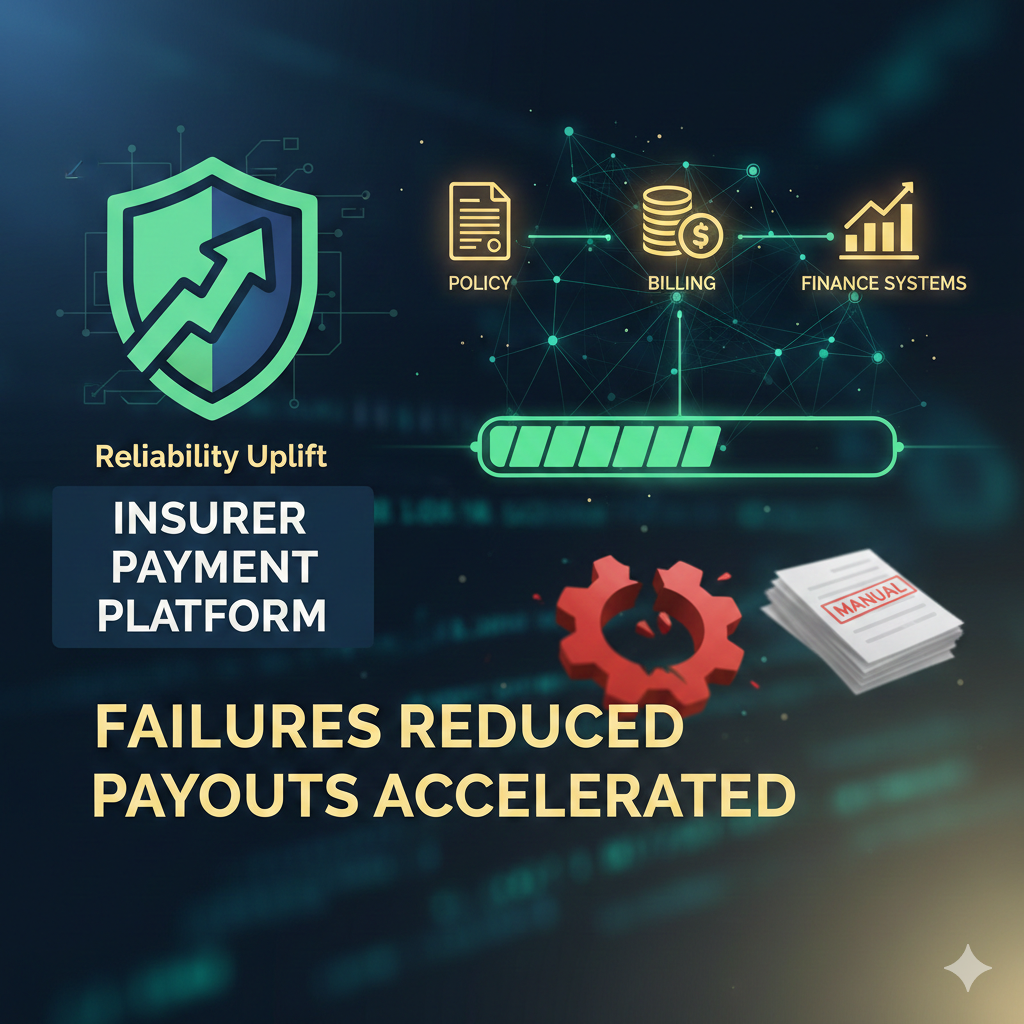
The payments platform was a bottleneck for policy servicing and claims payouts. Failures and manual reconciliations were increasing operational cost and audit effort. Interfaces with policy, billing, and finance systems were fragile.
Client Type
Leading Global Insurer
Region
North America
Engagement Type
Platform Modernization
Duration
9–12 months
Role
Program lead for platform modernization, Design, development, delivery governance, and rollout execution
What We Delivered
- Modernized payment orchestration and reconciliation workflows across multiple payment rails
- Standardized integration layer for policy admin, billing, general ledger, and partner gateways
- Exception management and reprocessing tools for operations teams
- Automated reconciliation reports and audit-ready payment trails
- Resilience improvements for peak-period payouts and batch processing
How We Delivered
- Designed target architecture with clear domain boundaries (payments, reconciliation, exceptions)
- Introduced CI/CD, environment parity, and release gating with automated testing
- Implemented idempotency, retry policies, and message correlation for integrations
- Delivered phased rollout by product line with rollback plans and parallel runs
- Ran weekly risk reviews with business, operations, and security stakeholders
What Made It Hard
- Multiple upstream/downstream systems with inconsistent data models and timing dependencies
- Zero tolerance for payout duplication; required strict idempotency and audit traceability
- Release windows constrained by business operations and month-end finance cycles
Results and Impact
Reduced Failure Rate
Reduced payment failure rate from ~1.8% to ~0.6% within 12 weeks of rollout.
Operational Efficiency
Cut manual reconciliation effort by ~35–45% through automation and exception tooling. Improved end-of-day batch completion window by ~30%.
System Stability
Achieved stable peak-volume processing with no Sev-1 outages in the last 10 weeks of the program. Reduced average incident resolution time from ~3–4 hours to <90 minutes.