
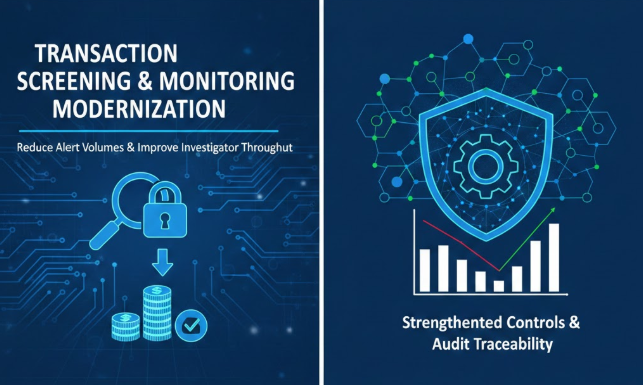
Transaction Screening & Monitoring Modernization
The bank needed to strengthen transaction screening and monitoring to reduce alert volumes and improve investigator throughput. Existing rules generated high false positives, and audit traceability across decisions was inconsistent. The program required strict governance and repeatable controls.
Client Type
Tier-1 Global Bank
Region
Global
Engagement Type
AI Enablement + Controls Modernization
Duration
12–15 months
Role
Delivery lead for platform buildout, model governance, and controls alignment
What We Delivered
- Screening and monitoring pipeline upgrades with configurable rule and score components
- Analyst workbench improvements for triage, case linking, and evidence capture
- Feature store design for consistent model inputs across channels
- Model monitoring dashboards for drift, stability, and alert volume tracking
- Governance artifacts: decision trace, change logs, and model validation pack template
How We Delivered
- Segmented the program into 'controls first' (traceability + audit trail) then 'signal quality'
- Built a controlled experimentation process (champion/challenger) with approval workflow
- Introduced data quality checks at ingestion and pre-scoring steps
- Implemented role-based access and segregation of duties for model/rule changes
- Performed shadow runs before cutover; tuned thresholds with investigator feedback loops
What Made It Hard
- Strict governance: every change required evidence, approvals, and traceable rollback
- Data fragmentation across channels and time zones; required normalized entity models
- Balancing alert reduction with risk sensitivity; tuning under conservative thresholds
Results and Impact
Reduced False Positives
Reduced false-positive alerts by ~18–27% across initial rollout corridors.
Improved Throughput
Improved investigator throughput by ~12–20% (cases closed per analyst per day). Cut average case handling time by ~15% via better evidence packaging and workflow.
Enhanced Traceability
Achieved consistent audit traceability (decision inputs + outputs stored per alert) for deployed changes. Reduced repeat alerts on the same entities by ~10–14% using entity linking.